
Supervised mode is not test mode
The two answer different questions, and an agent can only be in one of them.
Test mode wins wherever both are set, so an agent in test mode runs as a test whatever its supervision setting says. In the editor, turning one on turns the other off.
Supervise one run, or every run
One run. Open the agent in Executions, choose Run now, and turn on Supervised run. Pick who approves that run. Those technicians receive the cards for this run in place of the agent’s own approvers, and your choice is remembered in your browser for the next one. The agent’s saved settings do not change, so its scheduled and triggered runs are unaffected.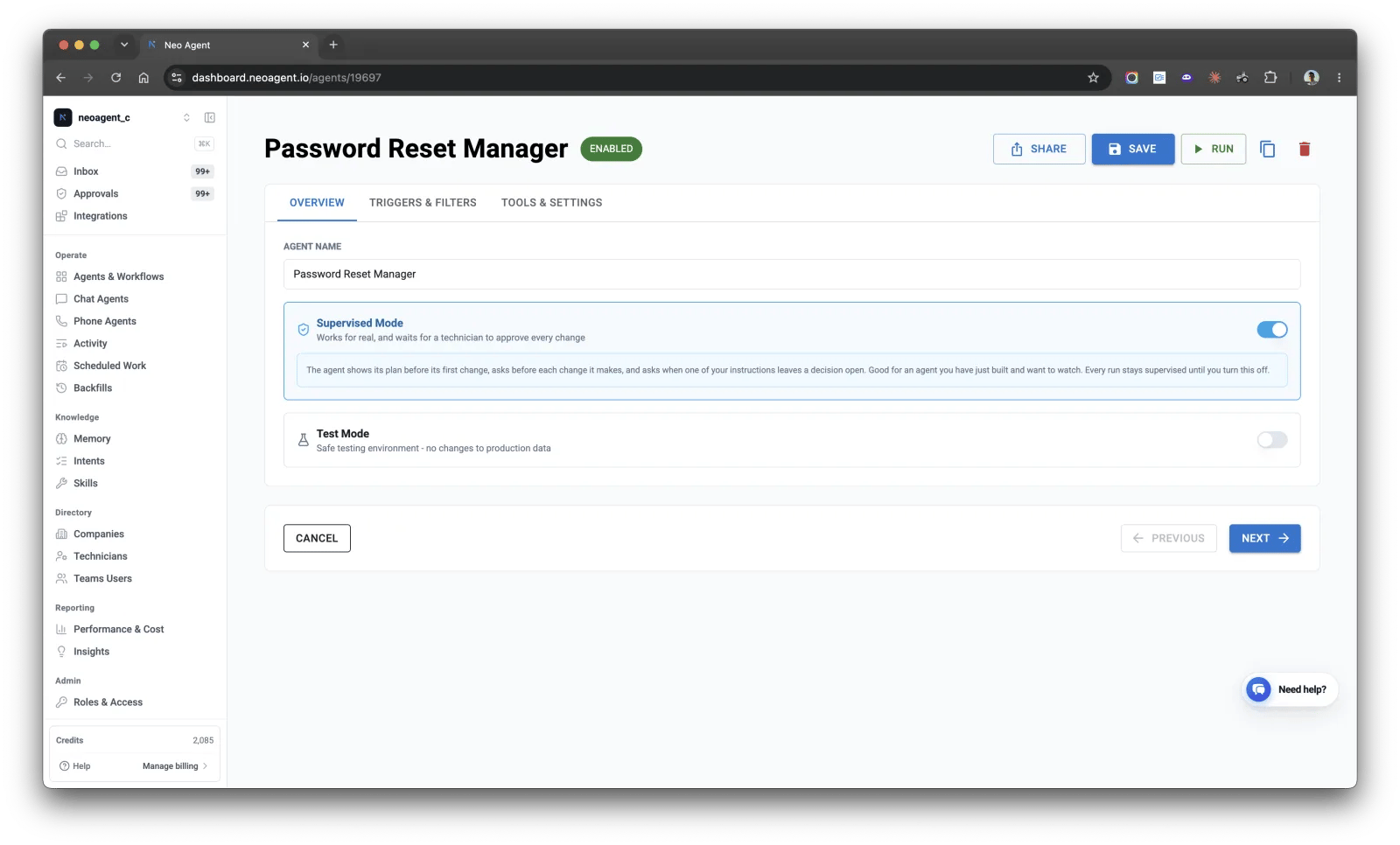
Supervised Mode on an agent's Overview tab
agent_settings.supervised through the public API, or ask the Neo Support agent, for example “turn on supervised runs for my onboarding agent”.
What the agent does on a supervised run
- It shows its plan first. Before its first change, it sends a card with how it reads the ticket and its instructions, and every change it intends to make. Approve it, or ask for changes and it sends a revised plan.
- Every change asks on its own, whatever the agent’s permission groups and tool settings say, with a card in three parts: the Action, the instruction it follows (Because), and what it read to decide (Evidence).
- It asks when your instructions leave a decision open: when two instructions conflict, when one can be read two ways, or when none covers a choice on which MSPs differ. The card shows each choice, the one it will follow if you approve, and suggested wording for your instructions.
What supervision does not cover
- Another agent or workflow. You approve the start, and what it runs then follows its own settings. Supervision covers the agent you switched it on for.
- The sandbox. You approve the command before it runs, not each change inside it, so one approval can cover several changes.
- Chat agents. The person in the conversation already approves each change, so the setting does not apply.
Before you turn it on
Somebody has to be able to approve. Supervision works through the Request Technician Approval tool. A one-off supervised run adds that tool for the run and uses the approvers you pick at Run now, so there is nothing to set up first. The saved Supervised Mode setting does need the tool on the agent with at least one approver. You can save such an agent as disabled without one, but not as enabled. It cannot run alongside sequential processing. Both hold the same lock. Turning Supervised Mode on turns sequential processing off and tells you it did. Going the other way, the sequential setting stays unavailable while the Request Technician Approval tool is enabled, so turn Supervised Mode off first. A run already under way cannot be supervised. An agent has one run at a time on a ticket, and supervision has to be set before that run starts. If the agent is still working, wait for it to finish or stop it, then start the supervised run.Supervised run checkpoints
What the plan card and the instruction question show
Technician-in-the-Loop
The approval system supervision runs on