The Teams apps Neo offers — the Neo AI Agent app, your branded end-user bot, and a custom internal bot — how to tell them apart, and which one to set up
Neo shows up in Microsoft Teams as several separate apps — easy to mix up, partly because more than one appears in a chat simply as “Neo.” Two questions pin down which you mean: who messages it (your technicians or your clients’ employees) and who answers (Neo’s managed assistant or an agent you built).
“Bot” vs “chat” are different things. A bot is the installable Teams app — the vehicle that carries notifications, cards, and messages into someone’s Teams. The chat is the agent that answers inside it. The three apps below are bots; what answers inside each is a chat agent (Neo Support, your end-user agent, or your internal agent). Pick both.
An older end-user bot, Neo Pulse (you may see it under a per-client name like “Acme IT Pulse”), predates the branded end-user bot — treat it as legacy; new rollouts use the branded end-user bot.
Separately, Technician Mapping & Availability maps technicians to their Microsoft accounts (so a chat agent can act as whoever is asking — “assign to me”, and PSA records under their own name) and optionally feeds their presence and shifts to Ticket Dispatch — it’s an integration, not an app.
Both the current Neo AI Agent and an older, now-retired Neo technician app appear in a 1:1 chat as “Neo” — you can’t tell them apart from the chat alone, yet notifications and approval cards only reach the current app. If a technician’s Teams notifications and approvals have stopped arriving (or just to be sure), (re)install the current app — installing is idempotent, harmless if they already have it. Identify it by its listing, not the chat name: Neo AI Agent on Microsoft AppSource, published by Neo Agent LTD — install it below.The rest of this page covers the Neo AI Agent app.
Neo Support — message the bot anything you’d ask the Neo Support Agent.
Answers from the Neo AI Agent app carry Teams’ AI generated label beside the bot’s name. Hover it and Teams shows its own note: AI-generated content may be incorrect. It marks chat answers only — approval cards and error notices don’t carry it, and neither do workflow notifications, whose wording a model may still have written. Your own branded bots are unlabelled: the label meets a Microsoft Store requirement that applies to the Neo app, and what your bots show is your call. If a reply is inaccurate, harmful or objectionable, send it to support@neoagent.io.
Installing is the registration: the moment the app lands in a technician’s Teams, Neo captures the delivery route and they become reachable for notifications and approvals — there’s no separate sign-up.
A Teams admin does this once for everyone in the Teams admin center: install it, then pin it to the sidebar.
1
Install for everyone
Teams apps → Manage apps → search Neo AI Agent → open it → Users and groups → Installs → Install app → Install to: Everyone (or a specific group/team) → Apply.
2
Pin it to the Teams sidebar
Teams apps → Setup policies → open Global (Org-wide default) (or a custom policy assigned to your techs) → Pinned apps → + Add apps → search Neo AI Agent → Add → order it → Save. Neo then sits in the left app bar so technicians can open Neo Support anytime, not only when a notification arrives. Policy changes can take a few hours to reach clients.
Each technician adds it from the Microsoft AppSource listing — open the Neo AI Agent listing → Get it now, then right-click it in the sidebar → Pin to keep it handy.
A technician without the app can’t receive Teams messages: the send fails for that person, the failure is reported in the action’s run output, and the workflow continues. There is no automatic fallback to email — configure Email as the notification channel explicitly where you want it.
The Technicians page marks every technician whose Microsoft account has the Neo AI Agent app with Teams installed, and its Teams app filter shows the technicians whose app is installed, not installed, or who have no Microsoft account linked. Neo links a technician to their Microsoft account by name after each technician sync, or you link one by hand in the technician’s Microsoft pane. When you select Add Technician, a PSA technician whose name matches, one to one, a Microsoft account that has the Neo AI Agent app and no technician yet is listed first, marked Uses Teams.People who use Neo in Teams but are not in your PSA, such as owners and service managers, are not on that page. They still receive the notifications and approval cards you send them.
Neo keeps one entry per Microsoft account that has used a Neo app, not one per human. If someone has more than one account that has used the app — an old account kept after a rename or migration, plus a separate admin account — each one is a separate entry with its own Entra ID.To remove one, ask the Neo Support Agent, for example “Remove Dana Patel’s old account from Neo in Teams”. It finds the account, shows you which one it means, and removes it once you confirm. Removing an entry:
takes it out of every Notify recipient picker
stops notifications and approval cards going to that account
leaves that person’s ability to chat with Neo untouched — they can still message the app and get replies
Removal sticks on its own. If the account messages the bot again it does not come back — that’s deliberate, so a removal you meant isn’t undone the next time that person says hello to Neo.To undo a removal, ask the Neo Support Agent to restore that person. A restored account is notifiable again straight away. There’s nothing for the person to reinstall and no need to wait for them to message Neo first — Neo kept their chat open the whole time, it just stopped treating them as a notification recipient.
Tell the Neo Support Agent which account by its Entra ID when one person has two. Removing the one they actually use stops their notifications — so check the Entra ID against the account in your Microsoft 365 admin center first. If the wrong one goes, ask it to restore that account.
Neo posts to a Teams channel or group chatthrough the Neo app itself — the same app that sends technician DMs and approval cards. The message arrives as a proper post from Neo, supports the same rich formatting, and doesn’t depend on any email plumbing.
1
Add Neo to the channel or chat
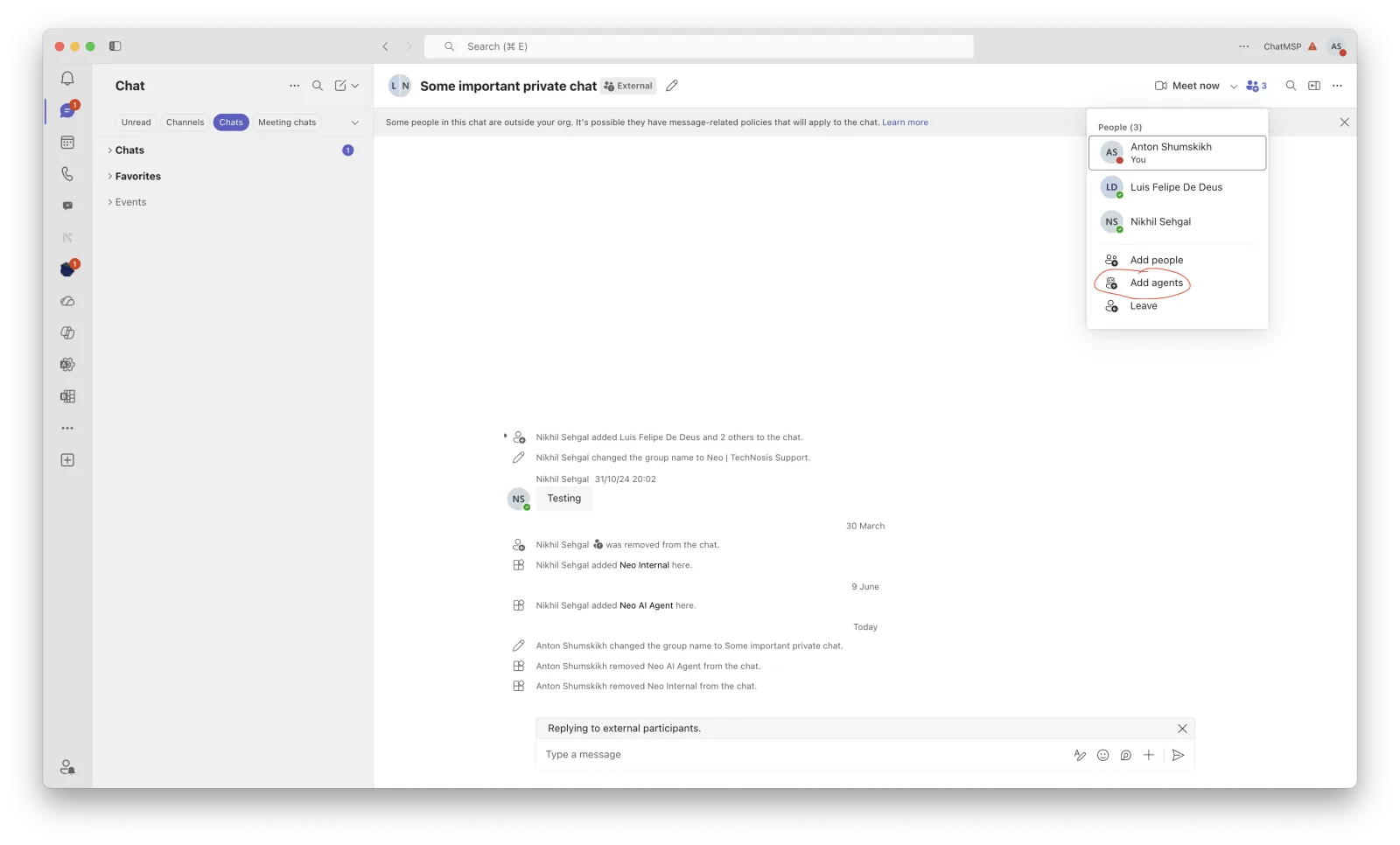
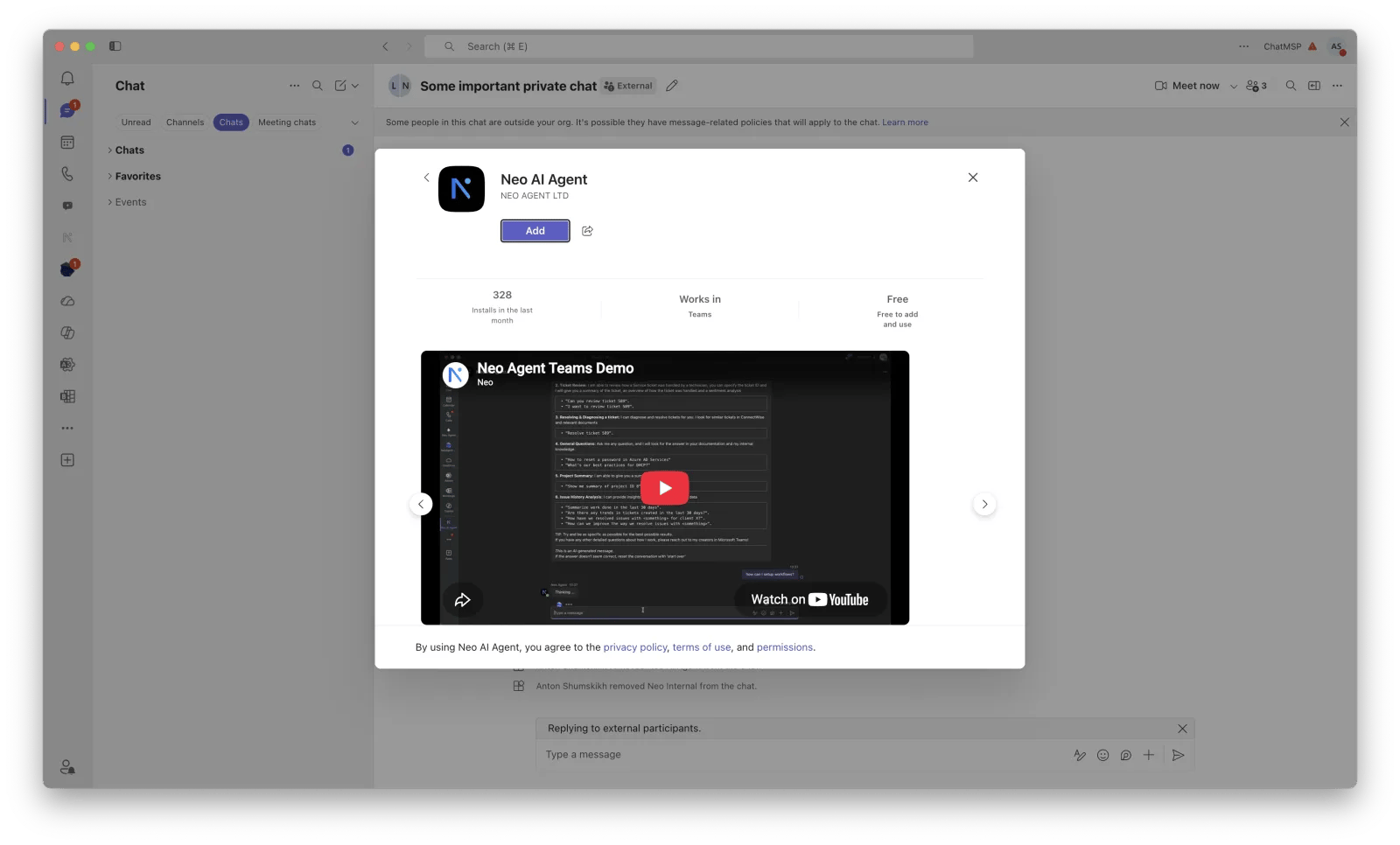
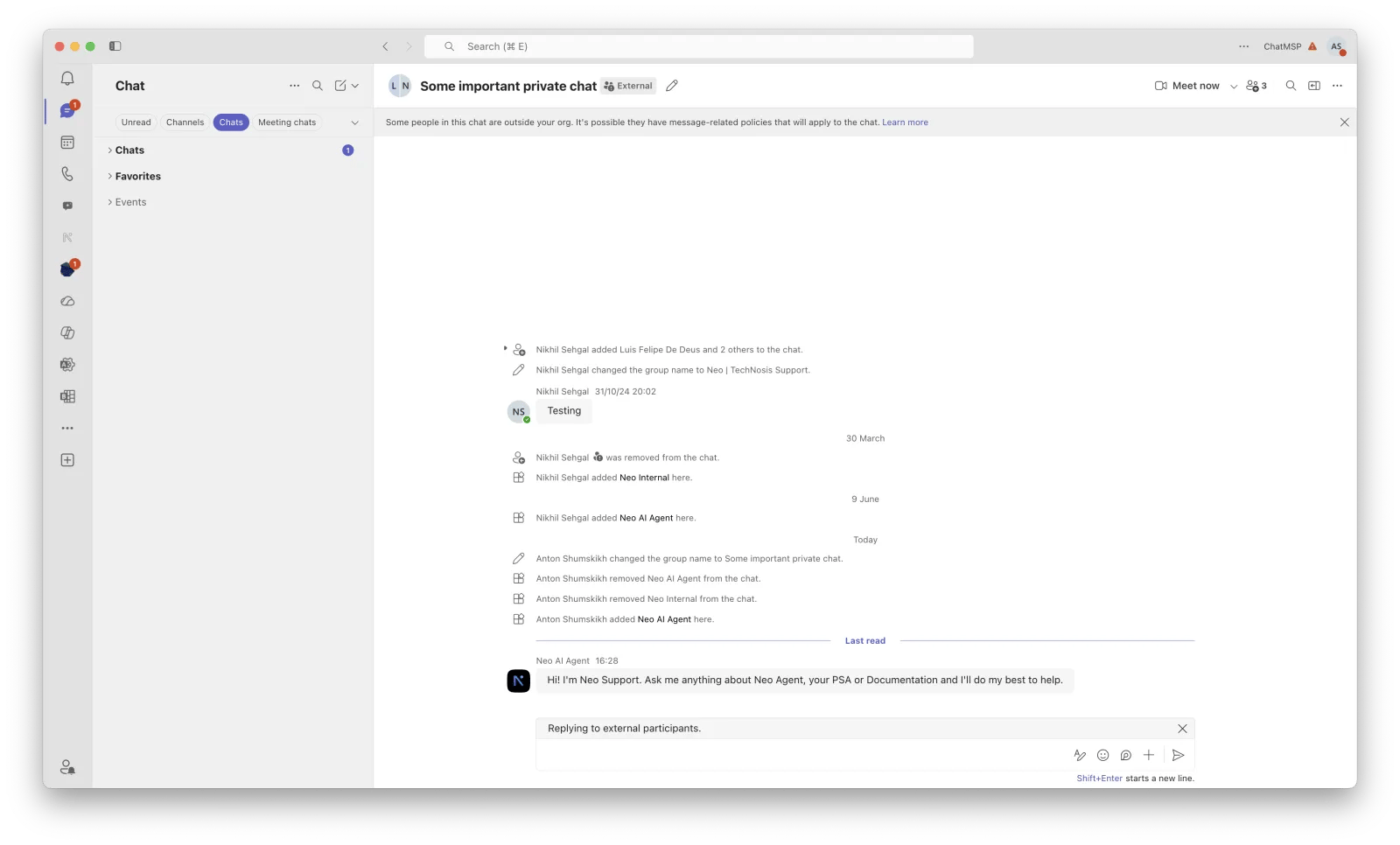
To a channel: a Team owner adds the Neo AI Agent app to the Team once — in the Team, open ··· → Manage team → Apps → More apps → find Neo AI Agent → Add. Every channel in that Team then becomes available to Neo; you don’t add it per channel.To a group chat: open the chat’s participants menu (top-right) and choose Add agents, then pick Neo AI Agent and click Add. Neo joins and posts a short hello — it’s ready to receive notifications.
In the chat's participants menu, choose Add agents
Pick Neo AI Agent and click Add
Neo joins and greets — the chat is now a notification destination
2
Pick it as a notification destination
In a workflow, open the Notify Internal Team action, set the channel to Teams, and choose from the Teams channels & chats picker (channels show as Team / Channel; group chats show their name). You can mix channels, chats, and individual technicians in one action.
In an agent, the Send Teams Message tool posts to a channel or chat — set its Channels & chats scope to Any or Only specific to allow it.
To let an agent read a channel, for example a channel where your team posts client travel, turn on the Read Teams Channel Messages tool and pick the channel.
Where Neo can post.Standard channels and group chats work as soon as the app is added. Shared channels (Teams Connect) are supported once your admin allows the app in shared channels.
Made a new channel? It joins the picker on its own — reopen the picker to see it. Private channels are the exception: Microsoft leaves them out of the Team’s channel list, and adding the app to a private channel does not put it in the picker. Mention @Neo AI Agent in the channel once, then reopen the picker. If Neo cannot read the channel’s name, the channel shows as Team / Unnamed channel. Picking it still allows only that one channel.
Renamed a Team or channel? The picker follows the new name after the next message anywhere in that Team.
Already using the email-address workaround? Switch it over. Older setups posted to a channel by emailing its connector address (…@amer.teams.ms). That path is fragile — it can show the wrong sender and occasionally double-posts (a Microsoft-side email quirk we can’t dedupe). Re-point each such Notify action to the native Teams channels & chats picker above and remove the channel email from the recipients. Native posting is the recommended way.
Legacy: post via the channel email address
Only needed for a Team you can’t add the Neo app into.
1
Get the channel email
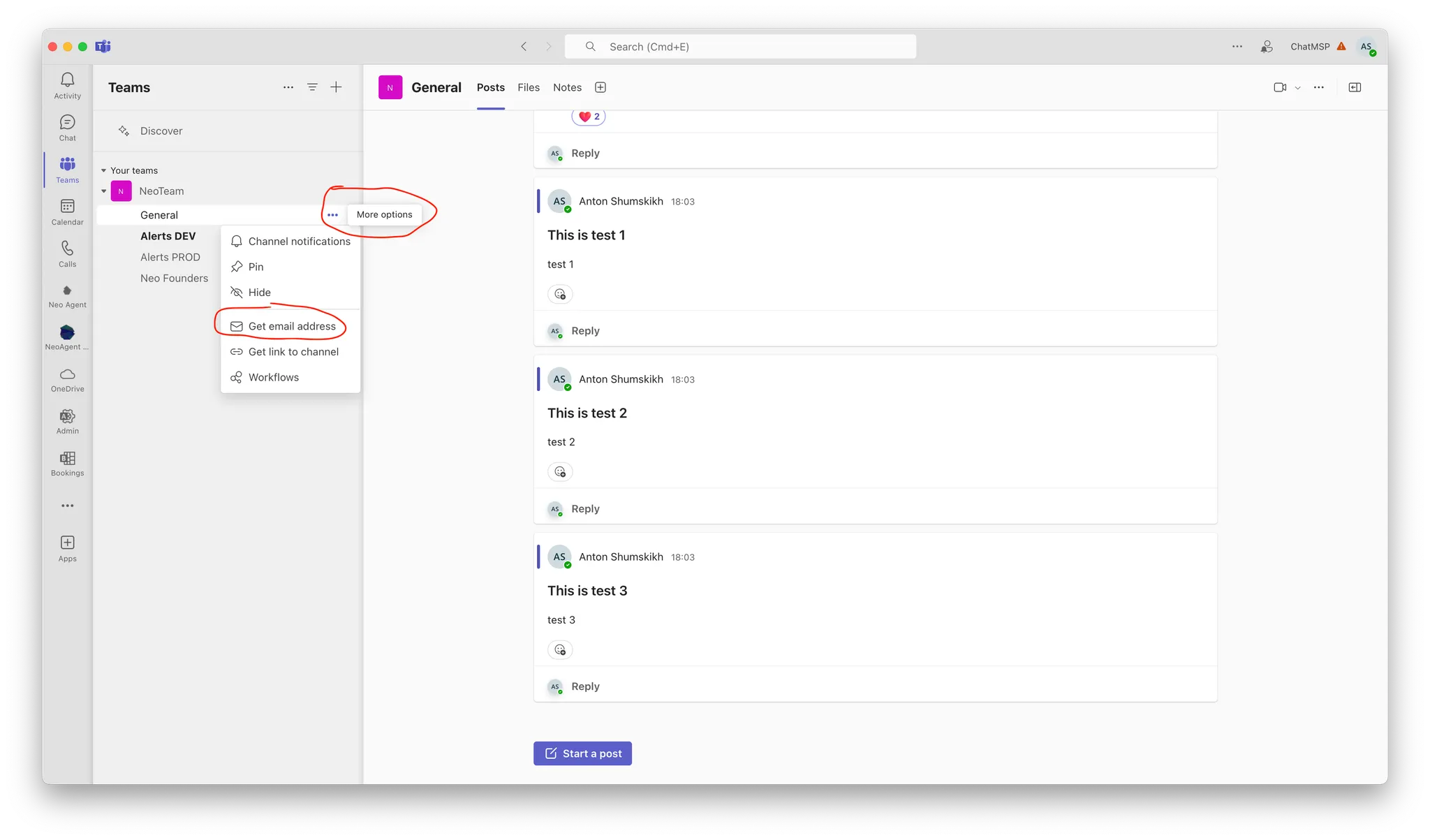
Open the channel → click ... → select Get email address.
2
Allow external senders
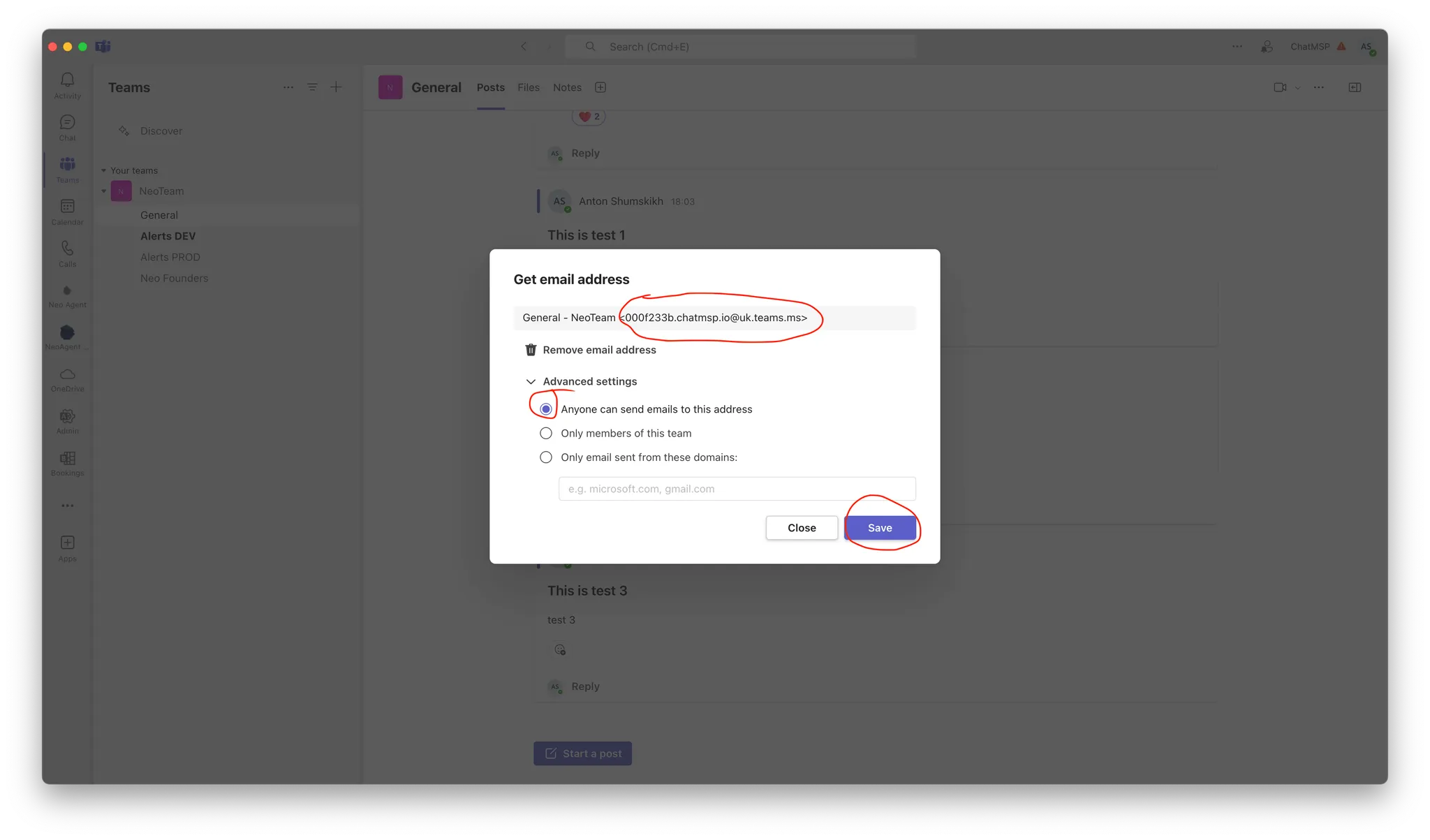
Open Advanced settings and enable Anyone can send emails to this address. Copy the email and save.
3
Use it in a Notify action
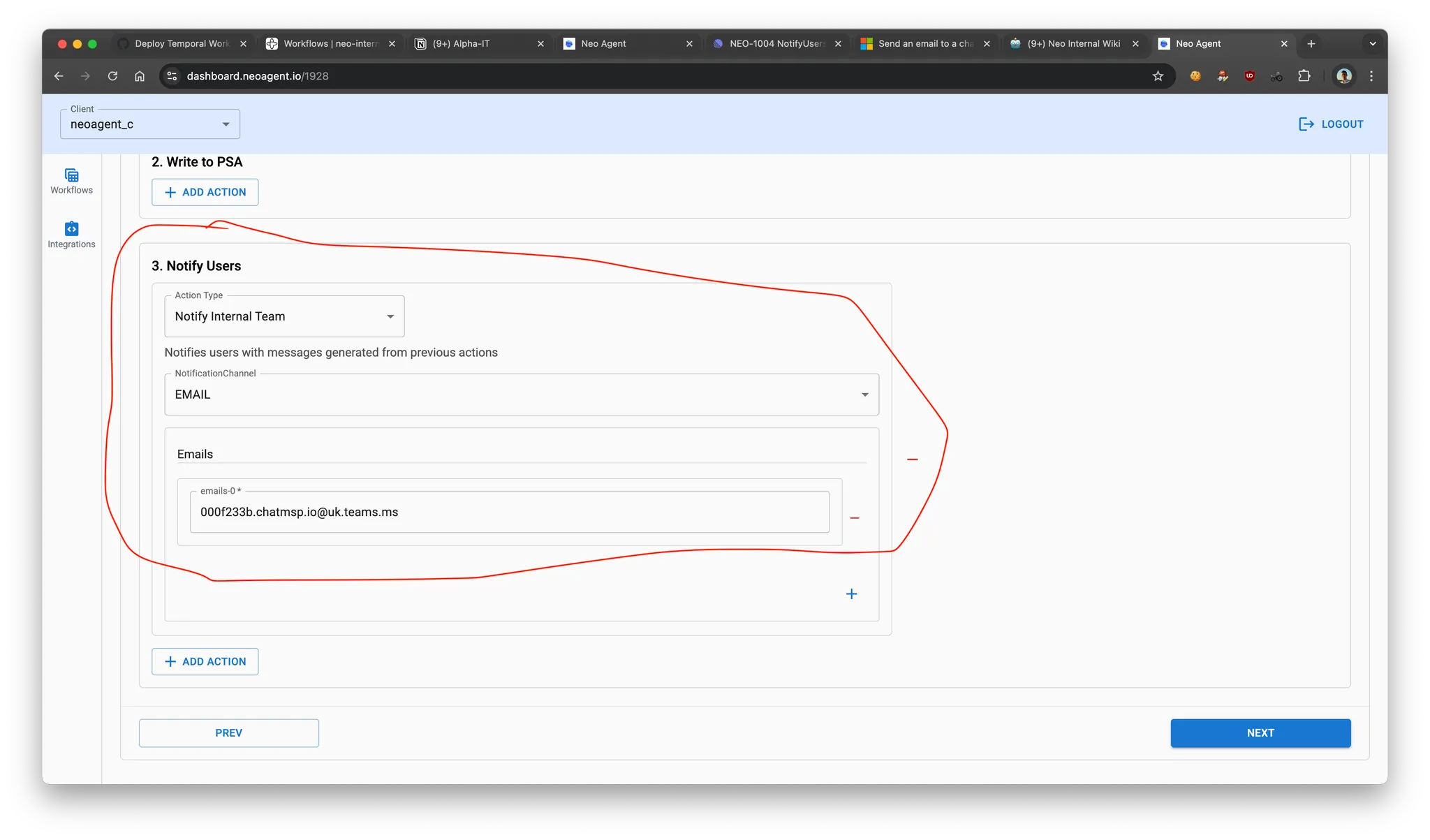
Paste the channel email into the Notify Internal Team action as an email recipient.
The same technician has two Microsoft accounts in Teams
They have two Microsoft accounts that have both used the Neo app — commonly an account kept after a rename or tenant migration, plus its replacement, or a personal and an admin account. The two entries carry different Entra IDs and are different Teams users to Microsoft, so Neo lists both.Notifications go to whichever of the two most recently messaged the bot. To make it unambiguous, remove the account they no longer use — see Remove someone from Neo in Teams.
A technician can't chat with Neo, gets no reply, or the chat box is greyed out
Their Microsoft 365 tenant has the Neo AI Agent app blocked. Microsoft then rejects every message and notification to that person with “(BotDisabledByAdmin) The tenant admin disabled this bot”, and Teams greys out the compose box. This is set in your own Teams admin, not in Neo — and it’s per-user, so some technicians can be working while others are blocked.Fix it in the Teams admin center: Teams apps → Manage apps → Neo AI Agent must be Allowed, and the app permission policy assigned to the affected technicians must permit it. Then have them re-open the app. Policy changes can take a few hours to apply.
Posts to a channel or chat stopped arriving
The run shows the post as failed with “the Neo AI Agent app is not a member of this team or chat” (Teams error BotNotInConversationRoster). Someone removed the Neo AI Agent app from that Team or chat, so Teams refuses every post from Neo there. Add the app back — see Post to a Teams channel or chat. For a Team, this brings back every channel in it.
Notifications or approval cards still arrive on the old 'Neo' app, not the new one
Two causes. Most often the technician is still only on the retired app — (re)install the current Neo AI Agent (idempotent; see Which “Neo” do I have?). If they already have the new app but it’s blocked by your tenant admin (above), Neo can’t deliver to it — clear the app block and have them re-open the app.
Assistant
Responses are generated using AI and may contain mistakes.